

How to Soften Hot Tub Water When Hardness Keeps Returning
Your calcium hardness reads perfect on a Tuesday, and by the weekend the water feels chalky again with a thin white ring creeping up the shell. That’s not chance, and it’s not something you did wrong.
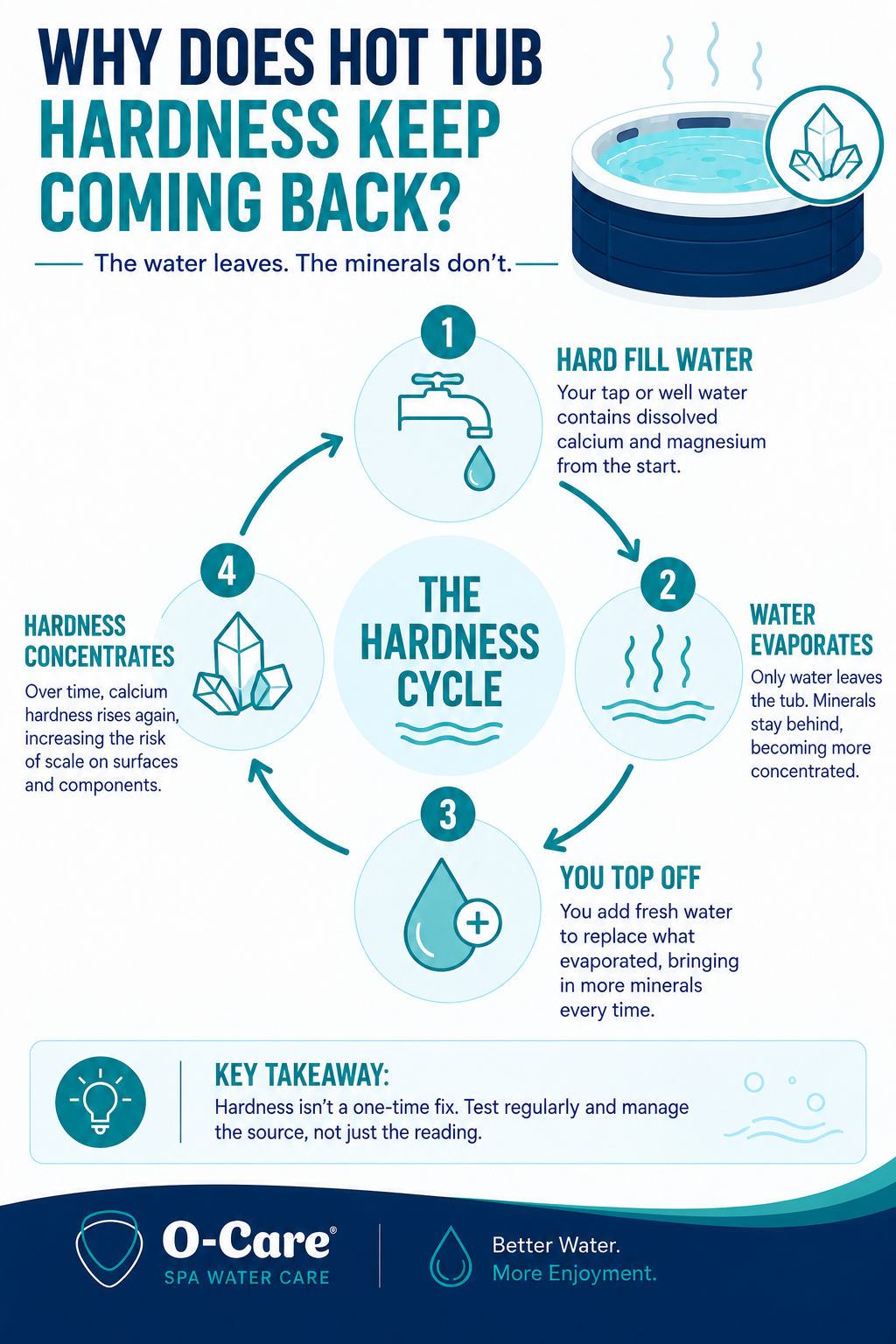
Learning how to soften hot tub water starts with understanding where the minerals come from: fill water carries dissolved calcium and magnesium the moment it goes into the tub, and every top-off and evaporation cycle after that concentrates them right back to where you started.
Softening hot tub water is less about one fix and more about matching the method to what’s actually happening. Here’s how to tell the difference.
Key Takeaways
- Softening methods reduce scale formation and move you toward soft water, but they don’t remove every dissolved hardness mineral.
- pH, alkalinity, and total hardness working together, not any single number, determine whether your water feels soft or starts scaling.
- Water can look completely clear and still be building scale, because mineral deposition depends on saturation, not on how the water looks or what your sanitizer reading says.
- Hardness reduction through dilution or ion exchange lowers scaling risk but adds upkeep: more frequent refills, more attention to the treatment itself.
- Hardness that keeps coming back is a fill-water and circulation issue as much as a chemistry one, which is why sequestration, filtration, and testing all have to work together.
What Water Chemistry Factors Actually Control Hot Tub Water Softness?
Maintaining balanced pH, alkalinity, and calcium hardness determines whether spa water feels soft or leads to scaling and irritation. Water outside the recommended ranges can corrode components, cause cloudy water, or allow mineral deposits to form even when sanitizer levels appear correct.
pH Levels
The pH level of your spa water indicates how acidic or basic it is. According to the CDC, you want to keep your water’s pH between 7.2 and 7.8:
- Water below 7 is acidic and can corrode your spa shell.
- Water above 7.8 can lead to scale buildup and cloudy water.
A strip test takes about fifteen seconds, and it’s the cheapest insurance you’ll buy for your equipment this year.
Total Alkalinity
The alkalinity level acts as a pH buffer, helping to stabilize the pH of your water. Ideally, your hot tub’s alkalinity should range from 80 to 120 parts per million (ppm).
If the alkalinity is off, it can cause swings in pH levels, which might result in scaling or corrosion. You can raise alkalinity with an alkalinity increaser, typically sodium bicarbonate, or lower it by adding an acid. Soda ash is a different product: it’s used primarily to raise pH, and only affects alkalinity as a side effect.
Calcium Hardness
Calcium hardness measures the amount of dissolved calcium minerals in your water. According to the Pool and Hot Tub Alliance, 150 to 250 ppm is a common target range for many conventional spas:
- Low calcium hardness can damage your hot tub’s heater and lead to foamy water.
- High levels might produce hard scales on the water’s surface and along the tub’s lining.
Scaling risk isn’t only about the calcium number on its own. pH, alkalinity, and water temperature all factor into whether dissolved minerals actually crystallize into scale. Manufacturer-specific targets can also differ, particularly for some saltwater systems, so check your spa manufacturer’s recommended range before treating a reading as a problem.
What Changes a Calcium Hardness Reading
Total hardness, which lumps calcium and magnesium together, is usually what a five-in-one test strip is actually reading when the two show up on the same pad. Raising calcium hardness means adding calcium chloride. Lowering it is different: most additives can’t pull dissolved calcium back out of the water, so bringing a high reading down usually means diluting with lower-hardness water or refilling.
Hardness climbs on its own over time, mainly from hard fill water, repeated top-offs, evaporation concentrating what’s already dissolved, and calcium-containing products like some sanitizers or pH adjusters. It isn’t something that spontaneously flips from low to high.
Why Does Hard Water Matter More Than Most Hot Tub Owners Realize?
Hard water can quietly damage hot tub components and reduce comfort long before scale becomes visible. Mineral buildup lowers heater efficiency, clogs plumbing, and makes water feel rough on skin. Total hardness is the number that quietly tracks all of this before scale ever becomes visible on a surface.
Common Effects of Hard Water
Understanding these effects helps prevent costly repairs and recurring maintenance problems.
Hard water problems often develop gradually, making them easy to overlook until performance declines. Common effects include:
- Scale buildup on shell surfaces, jets, and the heating element, the kind you don’t notice until you’re scrubbing it off during a drain
- Cloudy or dull water despite balanced chemistry readings
- Reduced heater efficiency, because scale acts like a blanket between the heating element and the water it’s supposed to be heating
- Clogged plumbing and filters from mineral deposits
- Dry or itchy skin after soaking
- More frequent chemical adjustments and draining
Because minerals accumulate over time, prevention is typically easier and less costly than removing heavy scale once it forms. Softened water can prolong the time between drain and refills in spas.
Why Can Hot Tub Water Look Balanced but Still Cause Problems?
Hot tub water can look clear and balanced while hidden imbalances are already developing. Regular testing is the only way to detect early shifts in calcium hardness, pH, alkalinity, and total hardness before they cause scale buildup, cloudy water, or skin irritation. Catching these changes early helps prevent recurring water problems.
How To Use Test Strips
Here are the steps you need to follow to use test strips:
- Dip a test strip into your spa water for the time specified on the test strip container, usually a few seconds.
- Pull it out without shaking off the excess water. Shaking strips the reagent pads before they finish reacting, which is the single most common reason two tests in a row give you different numbers.
- Hold the strip level and wait for the time recommended by the manufacturer before comparing the colors on the test strip to the color chart provided.
If you want a faster solution, try using a digital hot tub water tester.
How often to test the water?
Test your hot tub water at least once a week to ensure it remains healthy and balanced. More frequent testing might be needed if your spa sees heavy use or after a large water change.
If your numbers keep drifting no matter how often you test, a local dealer can run professional testing that catches trace minerals a five-in-one strip misses. Regular hot tub maintenance ensures you catch any imbalances before they become issues.
Why Does Calcium Hardness Keep Returning, and How Should You Adjust It Safely?
Calcium hardness has a way of creeping back even right after you’ve balanced it. The minerals never left the system, they diluted for a while, and every top-off and evaporation cycle concentrates them again. Lower hardness when scale is forming; raise it when the water turns corrosive.
Either direction, a lower calcium hardness swing or a climb toward the ceiling, tends to occur faster during a hot, heavily-used week.
How To Reduce Calcium Hardness
Reach for this when there’s too much calcium in the water, running above your spa’s recommended range alongside other signs of scaling. Dissolved calcium doesn’t come back out with an additive: a partial drain and refill with lower-hardness water is the most reliable fix. A compatible ion-exchange hardness-removal system (see the comparison below) can also pull it down without a full drain.
High calcium levels can lead to deposits of calcium scale on the surface of your spa. Read more on how to remove scale in this article: Fix Calcium Scaling For Surprisingly Better Hot Tub Water. Vinegar has a role there, but it’s for dissolving scale that’s already formed, not for lowering hardness in the water itself.
A complete drain and refill also resets the mineral load outright, and it’s worth doing every few months anyway to keep total hardness from creeping up in the background.
How To Increase Calcium Hardness
Low numbers aren’t a minor chemistry footnote. Water short on calcium starts pitting metal fittings and foaming within a season if you ignore it. Add calcium chloride, the standard calcium hardness increaser, and follow the product’s dosing guide exactly, since overshooting causes the exact scaling problem you’re trying to avoid.
Low calcium levels invite corrosion, high calcium levels invite scale. Track your calcium hardness level regularly and adjust in small steps rather than guessing.
This table lists the main products you can use to increase calcium hardness:
Type
Description
Application
Advantages
Calcium Chloride (granular or dihydrate)
The standard calcium increaser, a soluble salt that raises hardness quickly.
Added directly to the water in granular form.
Fast-dissolving and predictable.
Pre-Blended Hardness Increasers
Commercial hot tub products that combine calcium chloride with other balancing agents.
Sold with specific dosing instructions for hot tub volumes.
Clear directions, fewer dosing mistakes.
Calcium-Based Maintenance Kits
All-in-one kits that bundle a calcium increaser with the rest of your balancing chemicals.
Follow the kit’s own dosing chart.
One product covers the full balancing routine.
Which Water Softening Solution Works Best for Hard Water Hot Tubs?
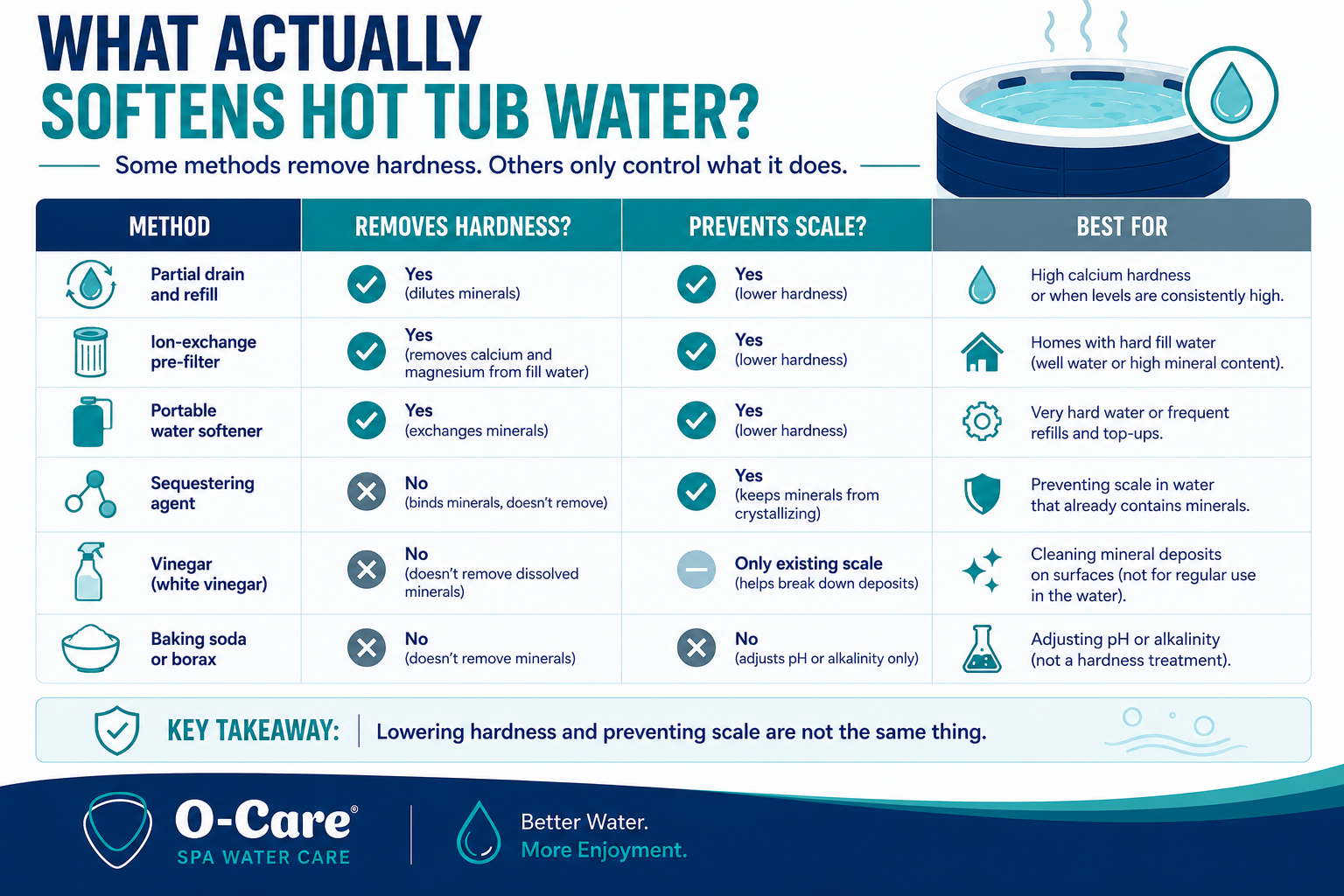
Different softening solutions solve hardness in different ways, and the difference matters more than the marketing on the label suggests. The right one depends on how high your total hardness runs and whether scale has already started forming on your equipment.
Pre-Filters and Sequestering Agents
A pre filter is a garden hose attachment used while filling. Not every pre filter actually removes calcium and magnesium: only the ones built with ion exchange resin do, so check the packaging rather than assuming any hose filter softens the fill water.
A sequestering agent, sometimes labeled scale control on the bottle, doesn’t remove anything. It keeps calcium and magnesium ions suspended so they can’t crystallize into scale, the gentlest way to manage water hardness without a full softening system.
Full Softening Systems
A full softening system pulls hardness out directly through ion exchange instead of suspending it. It costs more upfront and needs periodic regeneration, but it’s the most direct fix when your fill water is genuinely hard rather than only prone to scaling.
Comparing Your Options
Method
How It Works
Typical Cost
Maintenance Effort
Benefits
Tradeoffs
Pre-filter with ion-exchange resin (hose attachment)
Removes hardness minerals before water enters the spa, but only when it’s built with actual ion-exchange resin
Low initial cost; filter replaced periodically
Low
Prevents minerals from entering the tub; protects equipment; easy to use
Does not treat existing water; replacement needed after multiple fills; non-resin filters don’t soften at all
Sequestering agent / scale control
Binds calcium and keeps minerals dissolved to prevent deposits
Low ongoing cost
Low
Helps prevent scale buildup; improves clarity; simple weekly use
Does not reduce hardness levels; requires regular dosing
Portable softener system
Removes calcium and magnesium through ion exchange
Higher initial cost; periodic regeneration or service
Moderate
Significantly reduces hardness; protects heaters and plumbing; effective in very hard water
Higher cost; maintenance required; not always necessary for moderate hardness
Do Natural Methods Actually Soften Hot Tub Water?
No. Vinegar, baking soda, and borax adjust pH or alkalinity, but none of them remove dissolved calcium or magnesium from hot tub water. They can slow scale formation or help dissolve existing deposits, but they don’t lower a calcium hardness reading the way dilution or an ion-exchange system does.
Why Vinegar, Baking Soda, and Borax Don’t Count
This is the distinction that trips up most owners. Vinegar, baking soda, and borax show up in a lot of hot tub advice, but none of them remove dissolved calcium or magnesium from the water. What they actually do is nudge pH or alkalinity: baking soda and borax raise pH, vinegar lowers it. That’s a real effect. It isn’t a hardness effect.
Vinegar’s other reputation, that it “softens” a hot tub, comes from a different job entirely. It can help dissolve calcium carbonate scale that’s already deposited on surfaces and jets. That’s useful for cleanup, but it does nothing to the calcium still dissolved in the water, so it won’t move a hardness reading.
What Actually Changes a Hardness Reading
Sequestering agents work differently again: they keep calcium and magnesium suspended so the minerals can’t crystallize into scale, without pulling anything out of the water. Your hardness reading stays the same before and after using one. Scale prevention isn’t the same as hardness reduction, even though both get marketed as “softening.”
Spa manufacturers often advise against using a household water softener on spa equipment, since it’s built for a different volume and chemistry than a hot tub calls for. If your fill water is genuinely hard, the two approaches that actually change the calcium reading are dilution (see above) and an ion-exchange softening system (see the comparison below), not a kitchen-cabinet additive.
Where O-Care Fits Into a Hardness Routine (and Where It Doesn’t)
O-Care fits as support for the routine, not as a hardness fix: its mineral salts reduce the organic buildup that makes sanitizer work harder, cutting chemical demand by up to 78%. You still need to use chlorine or bromine, but less. It does not lower calcium hardness or reliably stop scale on its own; hardness still needs its own testing and treatment.
None of the natural fixes above solve what’s actually driving a lot of the maintenance load in your spa water: every soak leaves behind body oils, lotion residue, and organic waste your sanitizer has to fight through before it can do the job it’s actually there for.
That’s a separate problem from calcium hardness, but it usually runs alongside it, which is why a tub that’s hard on minerals is often also the one you’re shocking every other day.
That’s the gap O-Care’s mineral salts are built for. They break down that organic buildup once a week, so your sanitizer isn’t fighting through last weekend’s residue on top of everything else.
It’s not a water softener, and it won’t move your calcium hardness reading or reliably stop scale from forming on its own.
Less chemical swing in the water makes the rest of your routine easier to keep dialed in, but hardness itself still needs its own testing and treatment.
The Honest Limitation
You still need chlorine or bromine. That part doesn’t change. What changes is how much, and how often you’re correcting for it.
One O-Care customer summed it up on Trustpilot: “This is a great product, easy to use and does a great job making the spa water feel silky. We know our water is clean and odorless giving a nice feeling when you get out. Quite economical considering we get almost four months from a case.” (Ken, on Trustpilot)
Testing your water is still step one, hardness or not. O-Care goes in once a week, on its own schedule, alongside whatever you’re already doing to manage calcium.
Why Does Scale Keep Coming Back if Maintenance Routines Slip?
Filtration and circulation don’t remove the dissolved calcium and magnesium that make water hard, that’s a separate testing and treatment question. What they control is where hardness ends up: routine maintenance keeps minerals moving through the filter instead of settling as scale on the shell, jets, and heating element.
Skip it, and scale comes back even when the water’s actual hardness hasn’t changed. This routine maintenance is what keeps that from happening.
Routine Filter Care
Your spa’s filters play a vital role in catching mineral particles before they settle as scale. Cleaning and replacement are two different jobs, not one:
- Rinse or clean filters every 1 to 2 weeks. Leave it longer and the oil layer you can’t see starts working against your flow rate, not only your water clarity.
- Replace filters roughly every 12 to 18 months, sooner if a deep clean stops bringing them back to a clean color.
- Reduce calcium buildup on the pleats themselves, not only the shell.
Read more: Expert Hot Tub Filters Guide
Circulation and Filtration Adjustments
- Ensure your pump and filtration system are set correctly for optimal performance.
- Run the pump daily to circulate water, which helps distribute softening agents evenly.
- Adjust the filtration settings as needed to prevent scaling and maintain water clarity.
Read more: How To Thoroughly Clean Your Hot Tub Filter
Why Can Hot Tub Water Still Feel Harsh Even After Softening It? (Troubleshooting)
Spa water may still feel harsh when hidden hardness, mineral deposits, or imbalanced chemistry remain. Dry skin, cloudy water, or scale on heaters and surfaces often signal unresolved hardness issues. Identifying these signs and correcting filtration, fill water quality, and chemical balance helps restore softer, more comfortable water.
How To Identify The Signs of Hard Water
If you notice your skin feeling dry after a dip in the spa water or see cloudy water, you might have high total hardness. Scale deposits on the spa surfaces and heaters are also key indicators, and both can occur even when your last test looked fine. Here’s a quick test:
- Add a few drops of liquid soap to a water sample from your hot tub.
- Shake or stir vigorously.
- If the water doesn’t foam up and becomes cloudy, high hardness levels are likely.
Fix Corrosion and Skin Irritation Problems
Corrosion on your spa components and skin irritation are often related to water chemistry issues. You can take these steps to address them:
- When you fill your hot tub with fresh water, use a hose filter to remove impurities and reduce mineral content.
- If you’re having persistent issues, consider installing an advanced filtration system or water-softening agent.
- Regularly check and maintain the pH and alkalinity to prevent skin irritation and corrosion.
None of these fixes matter much if the water isn’t properly balanced first. Troubleshooting is ongoing, not a one-time fix, and a regular monitoring schedule is what keeps most of this from being a surprise.
Final Thoughts
Hardness isn’t a one-time fix. It’s a number that drifts with every fill and every evaporation cycle, which is why the owners who stay ahead of it test on a schedule instead of waiting for scale to show up on the shell.
Get pH and alkalinity locked in first, keep calcium and total hardness inside your spa manufacturer’s recommended range, and soft water with a lighter maintenance routine is what follows. If the scale keeps winning even when your numbers look right, O-Care’s weekly routine takes the organic load off your sanitizer’s plate so hardness isn’t the only number you’re chasing.
Read more on keeping the rest of your water chemistry in check:
- Fix Calcium Scaling For Surprisingly Better Hot Tub Water
- Water Testing
- How to Lower Alkalinity in Hot Tub Water
- Hot Tub Chemicals for Dummies
Frequently Asked Questions About Hot Tub Water Hardness
Can you lower hot tub calcium hardness without draining the water?
Sometimes, but not with an additive. Most products that claim to fight hardness are actually sequestering agents: they keep calcium suspended so it can’t scale, without removing it, so your test strip reading won’t change. To actually lower a hardness reading without a full drain, you need either a partial dilution with lower-hardness water or a compatible ion-exchange softening system running the water through it.
Does vinegar lower calcium hardness in a hot tub?
No. Vinegar can help dissolve calcium carbonate scale that’s already formed on surfaces, jets, or the shell, which is a real cleaning use. It does not remove dissolved calcium from the water itself, so adding vinegar to your spa won’t change a calcium hardness reading.
Should you fill a hot tub with softened water?
It depends on your spa and water-care system, so there isn’t one universal answer. Water that’s been through a household softener trades calcium and magnesium for sodium, and water with unusually low hardness can turn corrosive, pulling minerals from your heater, pump seals, and metal fittings to rebalance itself.
Some manufacturers recommend blending softened water with untreated fill water rather than using it straight, and some systems have their own calcium-hardness requirements that differ from general guidance. Check what your specific spa manufacturer and water-care system call for before filling with softened water.
Your calcium hardness reads perfect on a Tuesday, and by the weekend the water feels chalky again with a thin white ring creeping up the shell. That’s not chance, and it’s not something you did wrong.
Learning how to soften hot tub water starts with understanding where the minerals come from: fill water carries dissolved calcium and magnesium the moment it goes into the tub, and every top-off and evaporation cycle after that concentrates them right back to where you started.
Softening hot tub water is less about one fix and more about matching the method to what’s actually happening. Here’s how to tell the difference.
Key Takeaways
- Softening methods reduce scale formation and move you toward soft water, but they don’t remove every dissolved hardness mineral.
- pH, alkalinity, and total hardness working together, not any single number, determine whether your water feels soft or starts scaling.
- Water can look completely clear and still be building scale, because mineral deposition depends on saturation, not on how the water looks or what your sanitizer reading says.
- Hardness reduction through dilution or ion exchange lowers scaling risk but adds upkeep: more frequent refills, more attention to the treatment itself.
- Hardness that keeps coming back is a fill-water and circulation issue as much as a chemistry one, which is why sequestration, filtration, and testing all have to work together.
What Water Chemistry Factors Actually Control Hot Tub Water Softness?
Maintaining balanced pH, alkalinity, and calcium hardness determines whether spa water feels soft or leads to scaling and irritation. Water outside the recommended ranges can corrode components, cause cloudy water, or allow mineral deposits to form even when sanitizer levels appear correct.
pH Levels
The pH level of your spa water indicates how acidic or basic it is. According to the CDC, you want to keep your water’s pH between 7.2 and 7.8:
- Water below 7 is acidic and can corrode your spa shell.
- Water above 7.8 can lead to scale buildup and cloudy water.
A strip test takes about fifteen seconds, and it’s the cheapest insurance you’ll buy for your equipment this year.
Total Alkalinity
The alkalinity level acts as a pH buffer, helping to stabilize the pH of your water. Ideally, your hot tub’s alkalinity should range from 80 to 120 parts per million (ppm).
If the alkalinity is off, it can cause swings in pH levels, which might result in scaling or corrosion. You can raise alkalinity with an alkalinity increaser, typically sodium bicarbonate, or lower it by adding an acid. Soda ash is a different product: it’s used primarily to raise pH, and only affects alkalinity as a side effect.
Calcium Hardness
Calcium hardness measures the amount of dissolved calcium minerals in your water. According to the Pool and Hot Tub Alliance, 150 to 250 ppm is a common target range for many conventional spas:
- Low calcium hardness can damage your hot tub’s heater and lead to foamy water.
- High levels might produce hard scales on the water’s surface and along the tub’s lining.
Scaling risk isn’t only about the calcium number on its own. pH, alkalinity, and water temperature all factor into whether dissolved minerals actually crystallize into scale. Manufacturer-specific targets can also differ, particularly for some saltwater systems, so check your spa manufacturer’s recommended range before treating a reading as a problem.
What Changes a Calcium Hardness Reading
Total hardness, which lumps calcium and magnesium together, is usually what a five-in-one test strip is actually reading when the two show up on the same pad. Raising calcium hardness means adding calcium chloride. Lowering it is different: most additives can’t pull dissolved calcium back out of the water, so bringing a high reading down usually means diluting with lower-hardness water or refilling.
Hardness climbs on its own over time, mainly from hard fill water, repeated top-offs, evaporation concentrating what’s already dissolved, and calcium-containing products like some sanitizers or pH adjusters. It isn’t something that spontaneously flips from low to high.
Why Does Hard Water Matter More Than Most Hot Tub Owners Realize?
Hard water can quietly damage hot tub components and reduce comfort long before scale becomes visible. Mineral buildup lowers heater efficiency, clogs plumbing, and makes water feel rough on skin. Total hardness is the number that quietly tracks all of this before scale ever becomes visible on a surface.
Common Effects of Hard Water
Understanding these effects helps prevent costly repairs and recurring maintenance problems.
Hard water problems often develop gradually, making them easy to overlook until performance declines. Common effects include:
- Scale buildup on shell surfaces, jets, and the heating element, the kind you don’t notice until you’re scrubbing it off during a drain
- Cloudy or dull water despite balanced chemistry readings
- Reduced heater efficiency, because scale acts like a blanket between the heating element and the water it’s supposed to be heating
- Clogged plumbing and filters from mineral deposits
- Dry or itchy skin after soaking
- More frequent chemical adjustments and draining
Because minerals accumulate over time, prevention is typically easier and less costly than removing heavy scale once it forms. Softened water can prolong the time between drain and refills in spas.
Why Can Hot Tub Water Look Balanced but Still Cause Problems?
Hot tub water can look clear and balanced while hidden imbalances are already developing. Regular testing is the only way to detect early shifts in calcium hardness, pH, alkalinity, and total hardness before they cause scale buildup, cloudy water, or skin irritation. Catching these changes early helps prevent recurring water problems.
How To Use Test Strips
Here are the steps you need to follow to use test strips:
- Dip a test strip into your spa water for the time specified on the test strip container, usually a few seconds.
- Pull it out without shaking off the excess water. Shaking strips the reagent pads before they finish reacting, which is the single most common reason two tests in a row give you different numbers.
- Hold the strip level and wait for the time recommended by the manufacturer before comparing the colors on the test strip to the color chart provided.
If you want a faster solution, try using a digital hot tub water tester.
How often to test the water?
Test your hot tub water at least once a week to ensure it remains healthy and balanced. More frequent testing might be needed if your spa sees heavy use or after a large water change.
If your numbers keep drifting no matter how often you test, a local dealer can run professional testing that catches trace minerals a five-in-one strip misses. Regular hot tub maintenance ensures you catch any imbalances before they become issues.
Why Does Calcium Hardness Keep Returning, and How Should You Adjust It Safely?
Calcium hardness has a way of creeping back even right after you’ve balanced it. The minerals never left the system, they diluted for a while, and every top-off and evaporation cycle concentrates them again. Lower hardness when scale is forming; raise it when the water turns corrosive.
Either direction, a lower calcium hardness swing or a climb toward the ceiling, tends to occur faster during a hot, heavily-used week.
How To Reduce Calcium Hardness
Reach for this when there’s too much calcium in the water, running above your spa’s recommended range alongside other signs of scaling. Dissolved calcium doesn’t come back out with an additive: a partial drain and refill with lower-hardness water is the most reliable fix. A compatible ion-exchange hardness-removal system (see the comparison below) can also pull it down without a full drain.
High calcium levels can lead to deposits of calcium scale on the surface of your spa. Read more on how to remove scale in this article: Fix Calcium Scaling For Surprisingly Better Hot Tub Water. Vinegar has a role there, but it’s for dissolving scale that’s already formed, not for lowering hardness in the water itself.
A complete drain and refill also resets the mineral load outright, and it’s worth doing every few months anyway to keep total hardness from creeping up in the background.
How To Increase Calcium Hardness
Low numbers aren’t a minor chemistry footnote. Water short on calcium starts pitting metal fittings and foaming within a season if you ignore it. Add calcium chloride, the standard calcium hardness increaser, and follow the product’s dosing guide exactly, since overshooting causes the exact scaling problem you’re trying to avoid.
Low calcium levels invite corrosion, high calcium levels invite scale. Track your calcium hardness level regularly and adjust in small steps rather than guessing.
This table lists the main products you can use to increase calcium hardness:
| Type | Description | Application | Advantages |
| Calcium Chloride (granular or dihydrate) | The standard calcium increaser, a soluble salt that raises hardness quickly. | Added directly to the water in granular form. | Fast-dissolving and predictable. |
| Pre-Blended Hardness Increasers | Commercial hot tub products that combine calcium chloride with other balancing agents. | Sold with specific dosing instructions for hot tub volumes. | Clear directions, fewer dosing mistakes. |
| Calcium-Based Maintenance Kits | All-in-one kits that bundle a calcium increaser with the rest of your balancing chemicals. | Follow the kit’s own dosing chart. | One product covers the full balancing routine. |
Which Water Softening Solution Works Best for Hard Water Hot Tubs?
Different softening solutions solve hardness in different ways, and the difference matters more than the marketing on the label suggests. The right one depends on how high your total hardness runs and whether scale has already started forming on your equipment.
Pre-Filters and Sequestering Agents
A pre filter is a garden hose attachment used while filling. Not every pre filter actually removes calcium and magnesium: only the ones built with ion exchange resin do, so check the packaging rather than assuming any hose filter softens the fill water.
A sequestering agent, sometimes labeled scale control on the bottle, doesn’t remove anything. It keeps calcium and magnesium ions suspended so they can’t crystallize into scale, the gentlest way to manage water hardness without a full softening system.
Full Softening Systems
A full softening system pulls hardness out directly through ion exchange instead of suspending it. It costs more upfront and needs periodic regeneration, but it’s the most direct fix when your fill water is genuinely hard rather than only prone to scaling.
Comparing Your Options
| Method | How It Works | Typical Cost | Maintenance Effort | Benefits | Tradeoffs |
| Pre-filter with ion-exchange resin (hose attachment) | Removes hardness minerals before water enters the spa, but only when it’s built with actual ion-exchange resin | Low initial cost; filter replaced periodically | Low | Prevents minerals from entering the tub; protects equipment; easy to use | Does not treat existing water; replacement needed after multiple fills; non-resin filters don’t soften at all |
| Sequestering agent / scale control | Binds calcium and keeps minerals dissolved to prevent deposits | Low ongoing cost | Low | Helps prevent scale buildup; improves clarity; simple weekly use | Does not reduce hardness levels; requires regular dosing |
| Portable softener system | Removes calcium and magnesium through ion exchange | Higher initial cost; periodic regeneration or service | Moderate | Significantly reduces hardness; protects heaters and plumbing; effective in very hard water | Higher cost; maintenance required; not always necessary for moderate hardness |
Do Natural Methods Actually Soften Hot Tub Water?
No. Vinegar, baking soda, and borax adjust pH or alkalinity, but none of them remove dissolved calcium or magnesium from hot tub water. They can slow scale formation or help dissolve existing deposits, but they don’t lower a calcium hardness reading the way dilution or an ion-exchange system does.
Why Vinegar, Baking Soda, and Borax Don’t Count
This is the distinction that trips up most owners. Vinegar, baking soda, and borax show up in a lot of hot tub advice, but none of them remove dissolved calcium or magnesium from the water. What they actually do is nudge pH or alkalinity: baking soda and borax raise pH, vinegar lowers it. That’s a real effect. It isn’t a hardness effect.
Vinegar’s other reputation, that it “softens” a hot tub, comes from a different job entirely. It can help dissolve calcium carbonate scale that’s already deposited on surfaces and jets. That’s useful for cleanup, but it does nothing to the calcium still dissolved in the water, so it won’t move a hardness reading.
What Actually Changes a Hardness Reading
Sequestering agents work differently again: they keep calcium and magnesium suspended so the minerals can’t crystallize into scale, without pulling anything out of the water. Your hardness reading stays the same before and after using one. Scale prevention isn’t the same as hardness reduction, even though both get marketed as “softening.”
Spa manufacturers often advise against using a household water softener on spa equipment, since it’s built for a different volume and chemistry than a hot tub calls for. If your fill water is genuinely hard, the two approaches that actually change the calcium reading are dilution (see above) and an ion-exchange softening system (see the comparison below), not a kitchen-cabinet additive.
Where O-Care Fits Into a Hardness Routine (and Where It Doesn’t)
O-Care fits as support for the routine, not as a hardness fix: its mineral salts reduce the organic buildup that makes sanitizer work harder, cutting chemical demand by up to 78%. You still need to use chlorine or bromine, but less. It does not lower calcium hardness or reliably stop scale on its own; hardness still needs its own testing and treatment.
None of the natural fixes above solve what’s actually driving a lot of the maintenance load in your spa water: every soak leaves behind body oils, lotion residue, and organic waste your sanitizer has to fight through before it can do the job it’s actually there for.
That’s a separate problem from calcium hardness, but it usually runs alongside it, which is why a tub that’s hard on minerals is often also the one you’re shocking every other day.
That’s the gap O-Care’s mineral salts are built for. They break down that organic buildup once a week, so your sanitizer isn’t fighting through last weekend’s residue on top of everything else.
It’s not a water softener, and it won’t move your calcium hardness reading or reliably stop scale from forming on its own.
Less chemical swing in the water makes the rest of your routine easier to keep dialed in, but hardness itself still needs its own testing and treatment.
The Honest Limitation
You still need chlorine or bromine. That part doesn’t change. What changes is how much, and how often you’re correcting for it.
One O-Care customer summed it up on Trustpilot: “This is a great product, easy to use and does a great job making the spa water feel silky. We know our water is clean and odorless giving a nice feeling when you get out. Quite economical considering we get almost four months from a case.” (Ken, on Trustpilot)
Testing your water is still step one, hardness or not. O-Care goes in once a week, on its own schedule, alongside whatever you’re already doing to manage calcium.
Why Does Scale Keep Coming Back if Maintenance Routines Slip?
Filtration and circulation don’t remove the dissolved calcium and magnesium that make water hard, that’s a separate testing and treatment question. What they control is where hardness ends up: routine maintenance keeps minerals moving through the filter instead of settling as scale on the shell, jets, and heating element.
Skip it, and scale comes back even when the water’s actual hardness hasn’t changed. This routine maintenance is what keeps that from happening.
Routine Filter Care
Your spa’s filters play a vital role in catching mineral particles before they settle as scale. Cleaning and replacement are two different jobs, not one:
- Rinse or clean filters every 1 to 2 weeks. Leave it longer and the oil layer you can’t see starts working against your flow rate, not only your water clarity.
- Replace filters roughly every 12 to 18 months, sooner if a deep clean stops bringing them back to a clean color.
- Reduce calcium buildup on the pleats themselves, not only the shell.
Read more: Expert Hot Tub Filters Guide
Circulation and Filtration Adjustments
- Ensure your pump and filtration system are set correctly for optimal performance.
- Run the pump daily to circulate water, which helps distribute softening agents evenly.
- Adjust the filtration settings as needed to prevent scaling and maintain water clarity.
Read more: How To Thoroughly Clean Your Hot Tub Filter
Why Can Hot Tub Water Still Feel Harsh Even After Softening It? (Troubleshooting)
Spa water may still feel harsh when hidden hardness, mineral deposits, or imbalanced chemistry remain. Dry skin, cloudy water, or scale on heaters and surfaces often signal unresolved hardness issues. Identifying these signs and correcting filtration, fill water quality, and chemical balance helps restore softer, more comfortable water.
How To Identify The Signs of Hard Water
If you notice your skin feeling dry after a dip in the spa water or see cloudy water, you might have high total hardness. Scale deposits on the spa surfaces and heaters are also key indicators, and both can occur even when your last test looked fine. Here’s a quick test:
- Add a few drops of liquid soap to a water sample from your hot tub.
- Shake or stir vigorously.
- If the water doesn’t foam up and becomes cloudy, high hardness levels are likely.
Fix Corrosion and Skin Irritation Problems
Corrosion on your spa components and skin irritation are often related to water chemistry issues. You can take these steps to address them:
- When you fill your hot tub with fresh water, use a hose filter to remove impurities and reduce mineral content.
- If you’re having persistent issues, consider installing an advanced filtration system or water-softening agent.
- Regularly check and maintain the pH and alkalinity to prevent skin irritation and corrosion.
None of these fixes matter much if the water isn’t properly balanced first. Troubleshooting is ongoing, not a one-time fix, and a regular monitoring schedule is what keeps most of this from being a surprise.
Final Thoughts
Hardness isn’t a one-time fix. It’s a number that drifts with every fill and every evaporation cycle, which is why the owners who stay ahead of it test on a schedule instead of waiting for scale to show up on the shell.
Get pH and alkalinity locked in first, keep calcium and total hardness inside your spa manufacturer’s recommended range, and soft water with a lighter maintenance routine is what follows. If the scale keeps winning even when your numbers look right, O-Care’s weekly routine takes the organic load off your sanitizer’s plate so hardness isn’t the only number you’re chasing.
Read more on keeping the rest of your water chemistry in check:
- Fix Calcium Scaling For Surprisingly Better Hot Tub Water
- Water Testing
- How to Lower Alkalinity in Hot Tub Water
- Hot Tub Chemicals for Dummies
Frequently Asked Questions About Hot Tub Water Hardness
Can you lower hot tub calcium hardness without draining the water?
Sometimes, but not with an additive. Most products that claim to fight hardness are actually sequestering agents: they keep calcium suspended so it can’t scale, without removing it, so your test strip reading won’t change. To actually lower a hardness reading without a full drain, you need either a partial dilution with lower-hardness water or a compatible ion-exchange softening system running the water through it.
Does vinegar lower calcium hardness in a hot tub?
No. Vinegar can help dissolve calcium carbonate scale that’s already formed on surfaces, jets, or the shell, which is a real cleaning use. It does not remove dissolved calcium from the water itself, so adding vinegar to your spa won’t change a calcium hardness reading.
Should you fill a hot tub with softened water?
It depends on your spa and water-care system, so there isn’t one universal answer. Water that’s been through a household softener trades calcium and magnesium for sodium, and water with unusually low hardness can turn corrosive, pulling minerals from your heater, pump seals, and metal fittings to rebalance itself.
Some manufacturers recommend blending softened water with untreated fill water rather than using it straight, and some systems have their own calcium-hardness requirements that differ from general guidance. Check what your specific spa manufacturer and water-care system call for before filling with softened water.


